Tuesday, 11 September 2012
Ha Buey Hon
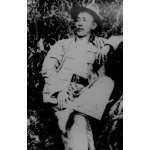
Ha Buey Hong (1871-1947) must have been responsible for the existence of hundreds or more of postal items of Sarawak. These included postal stationary, postcards and covers. Normally, philatelic items like these are held in low regard. Due to the sheer variety, interest and depth of his material, it has become a specialised area to collect within Sarawak philately.
This sole item that I have and probably will have, does give a lot of insight into his life. The front has an address for Bavaria, Germany. He literally corresponded with anyone around the globe who had a need for his services. The left bottom corner has his name and beneath it "C.C.C. 2724" in violet. This was his membership number for the Cosmopolitan Correspondence Club in Milwaukee. This club had over 6,000 members around the world who sent each other postcards.
While still working as a clerk for the Borneo Company, he was also trading as a stamp dealer. He became a skilful photographer and was personally responsible for much of the reproduction of his postcards. He used a very attractive cachet in violet with the address of his place of work. It was unusual that he was allowed to use his employer's address for his own private enterprise. It might have been that they hoped that he would be able to bring along extra business with his worldwide contacts.
The message shown demonstrated his line of work. I do admire his hand writing and a very fine signature to top it all. Thank you Mr Ha Buey Hon!
Update 6 June 2014. Thanks for the interest in this post. As a bonus I am adding this posthumous cover presumably sent by a family member after his death to fulfill a prior arrangement? It is also the only HBH cover that I know which has the very collectible AV2 cachet. The details of this cover is available in an issue of the Sarawak Journal last year.
If you are keen on collecting AV2s, try finding one on a non registered cover which are relatively rare.
Wednesday, 5 September 2012
Introducing Sarawak
Recently, I have accumulated a small collection of covers and postmarks of Sarawak. Rest assured that the bulk of my energies and resources will still be focused on NB. The history of Sarawak is arguably more interesting and has the romance of the white Rajahs. And also Sarawak did not have the sheer quantity of issues, overprints, varieties and CTOs that beset North Borneo stamps. Sarawak stamps are, however, lacking in interesting pictorial content. The postal history and postmarks are the strong points of collecting Sarawak. Being a neighbour in British Borneo, it is only natural to stray a bit into this territory.
K2 with a "S" within a diamond of parallel bars. There are 10 bars here but it is of a different shape to K1. The ones in deep violet are more uncommon. They were in use between 1875 and 1892. The difficult task would be to try to find this cancel on Straits, Hong Kong or possibly Indian stamps. Its use on SG1 was also very uncommon.
The example on the left is possibly a fake with thinner lines with more squared proportions.
Reference: Sarawak Journal
I wondered why it was cancelled twice. On turning it the other way up, one can see JAN 61. It would appear that this was the initial cancel that was applied as it has more ink. When the postal clerk realised that he has inserted the year slug the wrong way round, he corrected it. He then applied another cancellation with the correct date and also the right way up.
This is the Kuching K1 cancellation of parallel bars on SG1 which was in use between 1864 and 1872. There was a question as whether it constituted 9 or 10 bars. This example does show clearly that it was made of 10 bars even though the bottom bar was shorter. It was thought that the hand stamp was made of ivory and through use the bottom bit broke off. However, there are examples on cover which shows a clear 9 bar cancel. So it was possible that there might have been 2 types of K1 type cancellations which were in use. It has also been argued that 10 bars is more symmetrical and would make a more perfect square. However there are stamps cancelled with a perfect well defined and complete 10 bars and these are invariably forged cancellations. Interestingly, the K1 illustrated in Ted Proud's book shows 11 bars.
Reference: Sarawak Journal
A partial K1 cancellation on a 1871 SG2 stamp, possibly a fake. It is very rare to find it on this issue of stamps as the use of the K1 was finished by 1872. K1 may also be found on stamps of the East Indies.
The example on the left is possibly a fake with thinner lines with more squared proportions.
I rather like this one with its design and generous proportions. This is the D1 in Proud's classification. It should be very nice on cover or on a strip of stamps. It is in black but there is at least one record of it in violet. On SG1, it would be extremely rare when genuinely used.
This "PAID" PD1 marking shows that there is still a lot to be learned about postmarks and cancellations. It was used for about 6 months from December 1876 according to Proud but on a gold medal display in Stampex, it mentioned 1871 to 1877. The status of this mark is still open to question. It was thought that it was used to mark outstation mail arriving at Kuching destined for overseas. There is also some indication that it was employed as a form of registration mark.
Reference: Sarawak Journal
Got this smudged Lawas cancellation on piece for £1 from the recent society packet round. It is more interesting than I initially thought. It has a date of 9 JAN 16.
Subscribe to:
Posts (Atom)
