Wednesday, 7 September 2016

The 1/2c stamp of the 1889-1892 P&R issue


The half cent stamp was issued in 1889. It comes in the two shades of magenta and rose. There were 5 different transfers, each with a slight variation in colour but only two shades are listed in the SG catalogue. I am often puzzled by the issue of the half cent stamp as it was not related to any ongoing postal rate and also unlikely any revenue rate either.


These are the two shades of colour. There are quite a few constant flaws to look out for in the authentic half cent stamp. For practical purposes and to make things simple it is better to concentrate on the easy points. The real stamp lacks the extra stroke between the first and second horizontal strokes of the first Chinese character on the right hand side.  In addition the other easy to notice constant feature is the coloured dot on the right side of 2 in 1/2 cent.

This is the CTO imperf pair in rose and clearly shows the coloured dot next to 2 and lacking the extra stroke in the Chinese character.


Both of these are very good fakes. The left item shows the extra stroke clearly and also lacks the coloured dot next to 2. The other very important feature is the smaller and raised c in CENT. The right stamp is the corrected version without the extra stroke in the first Chinese character. It is an uncommon forgery but it still lacks the coloured dot and also has the abnormal looking c in CENT. There is also a slight curve in the second and third horizontal strokes of the first character in the forgery. So with these features alone, one can confidently pick out the forgery and the normal stamp. The corrected forged stamp is worth looking out for.         
                                                                                           
This pair compares the original half cent stamp with the corrected Fournier on the right with the coloured dot next to 2 missing and the slightly raised C in CENT. The perforations are well matched but the paper that these half cent forgeries were printed on has a dull brownish tinge. On the forgery there is also a very well executed bar cancellation. You can click on this image for a closeup and look for the other subtle differences especially with the Chinese characters on the right side. Please also note that the scroll containing POSTAGE & REVENUE touches the outer frame on both sides and there is noticeable gap on the left side with the forgeries.

These three are all forgeries together with fake cancellations. The last stamp has bars that are almost the same as the 14 bar cancel used at Sandakan. I have reasons to think that the stamp in the middle is a Carame and the other two from Fournier. The Carame has a better printed quality and also the presence of the fake Labuan bars (Selsor, Sarawak Specialist Society).  The last stamp on the right has the shade in rose but that is probably because it was over soaked and faded. Magenta is the norm for the Fournier half cent forgeries. 

This is mainly to show that there is a slight variation in height in stamps of this issue. The half cent stamp is the tallest stamp of the group and probably that it was printed at a different time than most of the group. The 6c is the shortest and was the last to be issued in 1892.
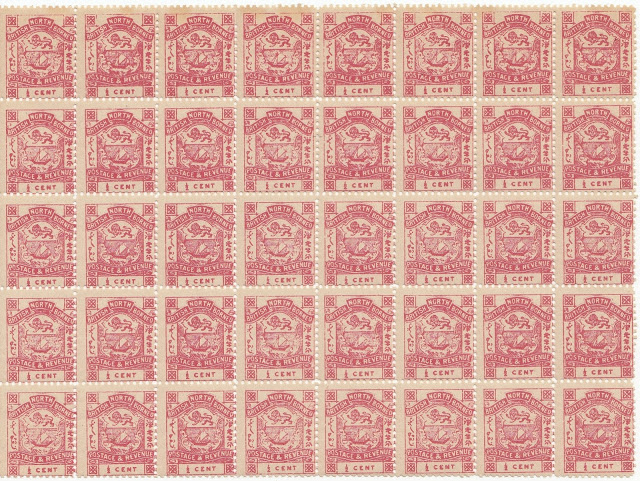
A part sheet of 40 of the half cent forgery of the crude set. The printing is not precise and was said to be in sheets of 100. Multiples of the crude multiperf stamps are more uncommon than those from Fournier. But it is rather strange that the extra stroke in the first Chinese character is also present here. Curiously, it would seem that this value in particular was copied from the Founier/Careme forgeries.

Update 12/10/2016
I bought this full sheet of the Carame half cent forgery. The difference with Fournier is not very apparent to me. I was told about the quality of printing, the more accurate colour and the evenness of the whole sheet and perforations etc but nothing easy to understand and used in practice. There may be further updates as I study this sheet carefully. 

Thursday, 1 September 2016

An introduction to forgeries of the low values of the 1889-1892 P&R issue


The release of this issue of postage and revenue stamps allowed the use of postage stamps for the payment of revenue duties in North Borneo. They were engraved by Thomas McDonald and printed by Blades, East & Blades in London. Most of the values were likely to have been printed over a short period of time initially but different values were officially released at different times over a period of three years.
They were ordered in 1887 when it was realised that the 1886 issue did not have the right inscription to include use for revenue purposes. The printing was likely to be completed by 1888 but not sent to North Borneo until 1889. In a famous trial involving John Stewart Lowden and Henry Revell Harmer in 1909, this was consistently referred to as the 1887 issue including the engraver Thomas McDonald himself.  
It was the first mass produced issue that was CTO with 14 bars and sold on cheaply to collectors. So the market was and still is flooded with many of these CTO stamps. Somehow forgers also decided to mass produced this issue even though it was impossible to sell them on other than very cheaply.
Most general and specialised collectors would have some of these CTO and forged stamps in their collection. The study of the various forgeries and how to differentiate between them is a very interesting exercise. I am also surprised that some of the forgeries are not that common. Not all forgeries are undesirable. A Sperati example of this issue, if it ever exists, would be worth a tidy sum of money. As shown next week, a corrected example of the half cent forgery is very well worth looking for.
There were hand painted essays, die proofs, composite proofs and colour trials of these stamps which I shall not mention further as I do not have any of them. There were also different printings and up to five different transfers per stamp which can be useful for plating purposes.


These are crude and common forgeries in various perforation and has been described as "crude multiperfs". The printing is not clear and the ink seems to be lumpy. Unfortunately, ebayers still buy them as genuine. It is not clear what their origins were. They were first noticed in 1922. They remind me of the Japanese Kamigata forgeries but those originated from the early 20th century. Some of them have  a "postmark" and occasionally they are imperf. 


When they are singly imperf like this, you can almost be certain that they are forgeries from Rene Carame or Francois Founier. Genuine stamps are also available as imperfs but they are normally in pairs. I am still not clear how one differentiates between a Fournier and a Carame. That would something to write about at a future date.


These imperf pairs are all forgeries. It is more likely to be authentic when these imperf pairs have normal looking bar cancellations.

Finally, forgeries are sometimes cancelled with these crude thick bar cancels, supposedly to confuse them with the Labuan 9 bar cancellation but they are quite different. They are said to have originated from Carame (Selsor, Sarawak Specialist Society). In the next few weeks, I can also show forged bar cancels which are very similar to the genuine 14 bar cancellations. Some also have unclear cds cancels but if they are the double ring type, then they are most certainly fakes.