Saturday, 13 August 2022

Labuan errors and varieties update

The original post was in September 2020. Readers can read it again by clicking the link here. Since then I have managed to find some other items which maybe of interest.


This is the 6c orange brown from the 1880 issue as seen by the clear Crown CC watermark. It is the "no dot in Jawi upper left" variety.


Somehow I have managed to collect 4 used and 1 mint copy. Stamp no. 4 has a unusual rare cancellation which was probably the fore runner of the subsequent very common 9 bar cancellation.


I have acquired another interesting re-entry stamp of the 1896 Jubilee overprint issue. This is the stamp on the left with a different re-entry to the right of the palm tree. Not only this, the stamp was perforated and cut to a smaller size. Look carefully at the last letter in "Jubilee" and the "E" looks a bit different. I thought it was possibly omitted during the overprinting and then reinserted subsequently but that would be too much of a occurrence. These re-entries are so obvious and should justify being listed as an additional variety in the catalogues. Again readers can refresh on what was written before in this blog by clicking this link. 

Update 16 Aug 2022
Went to the local stamp fair today and bought these two stamp varieties.


The 10c brown has the "missing stroke to Chinese character" and the 16c blue, the "no right foot to second Chinese character" varieties.

A timely reminder to my faithful readers 2 sayings there can describe the richness and mysteries of philately:
Philately is the art of uncovering errors, mistakes and imperfections.
The last word in philately is never written.

So long these 2 statements endure, I shall carry on collecting stamps!

Wednesday, 27 April 2022

Trains, trains and trains


It is generally men who are interested in trains. The majority of philatelists and deltiologists are also men. So trains depicted on stamps and postcards are popularly collected. Well, there is no lack of material where North Borneo is concerned. 

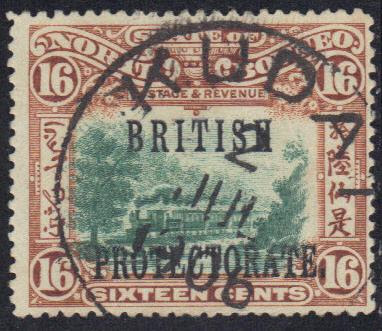
The first North  Borneo stamp depicting a train was from 1897 issue. 16c was a very unusual value and then it was overprinted in 1901 with British Protectorate.

It was also overprinted for use as a postage due even though I doubt there was much actual usage of this value.

This was part of  issue in 1951 to celebrate the 75th Anniversary of North Borneo Company. It is very nice to have it with a train mail cancellation. I have seen a cover with this combination but unfortunately the cover was rather plain and I decided to wait for a better example.


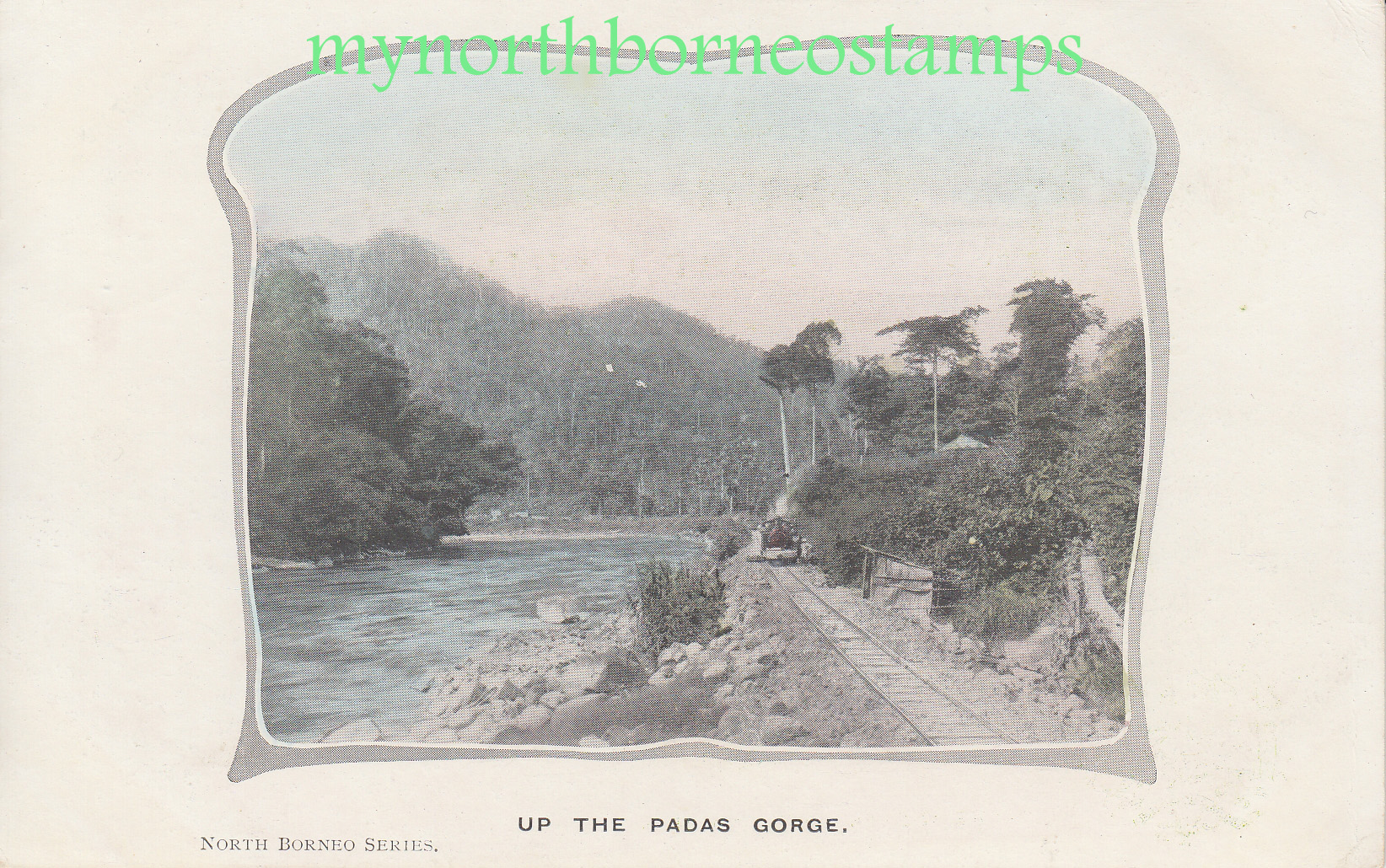
A series of North Borneo Government printed colour postcards showing the train in the early days of the railway. These cards are quite uncommon especially used ones.


These are photographs expertly taken by CF Leong at the Happy Studio in Jesselton probably in the early 1970s. 


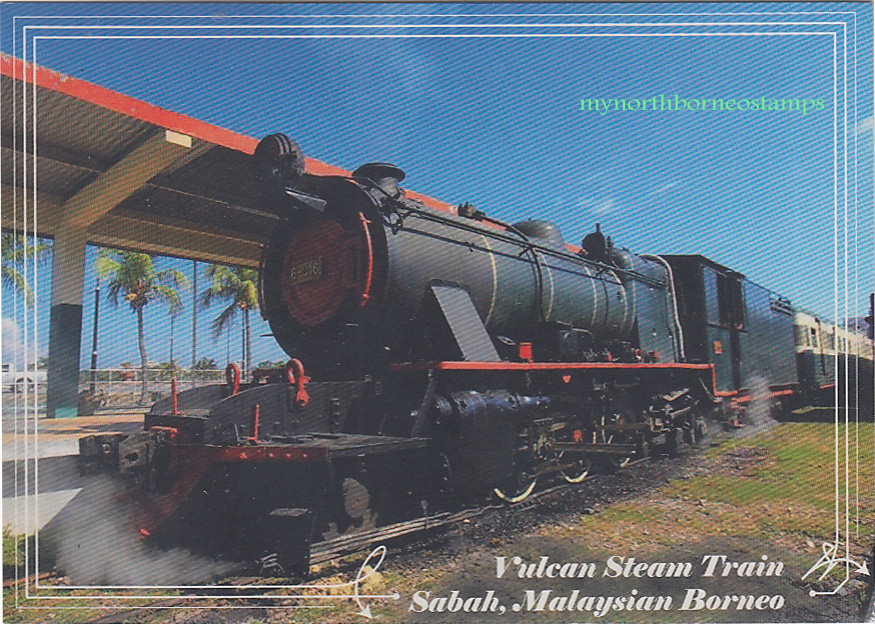
These postcards are relatively new but they may not be that common. This is the Vulcan Steam Locomotive 6016. They were delivered in 1956, built by Vulcan Foundry Ltd in Lancashire England. They were withdrawn from use in 1972 but luckily well preserved and currently back in usage for the tourist train to Papar.
 

I think that the Hitachi diesel locomotives are very functional and unattractive looking in comparison to the Vulcans. Diesel locomotives were delivered in 1968 to replace the steam locomotives. This Hitachi locomotive numbered 5101 was originally 6101, delivered in 1980. Around that time on a school sponsored trip, a group of us went with one of these locomotives up the Padas Gorge from Beaufort to Tenom. And then a few years ago, I took the journey in reverse from Tenom to Halogilat (half way to Beaufort) again with this type of locomotive with bare facilities but the views were good.  

This stamp of Malaysia issued in 2015 depicts the Hitachi diesel engine used by North Borneo Railway.

This miniature sheet from 2015 shows the Vulcan locomotive passing the Papar Bridge.